




SPACE February 2026 (No. 699)
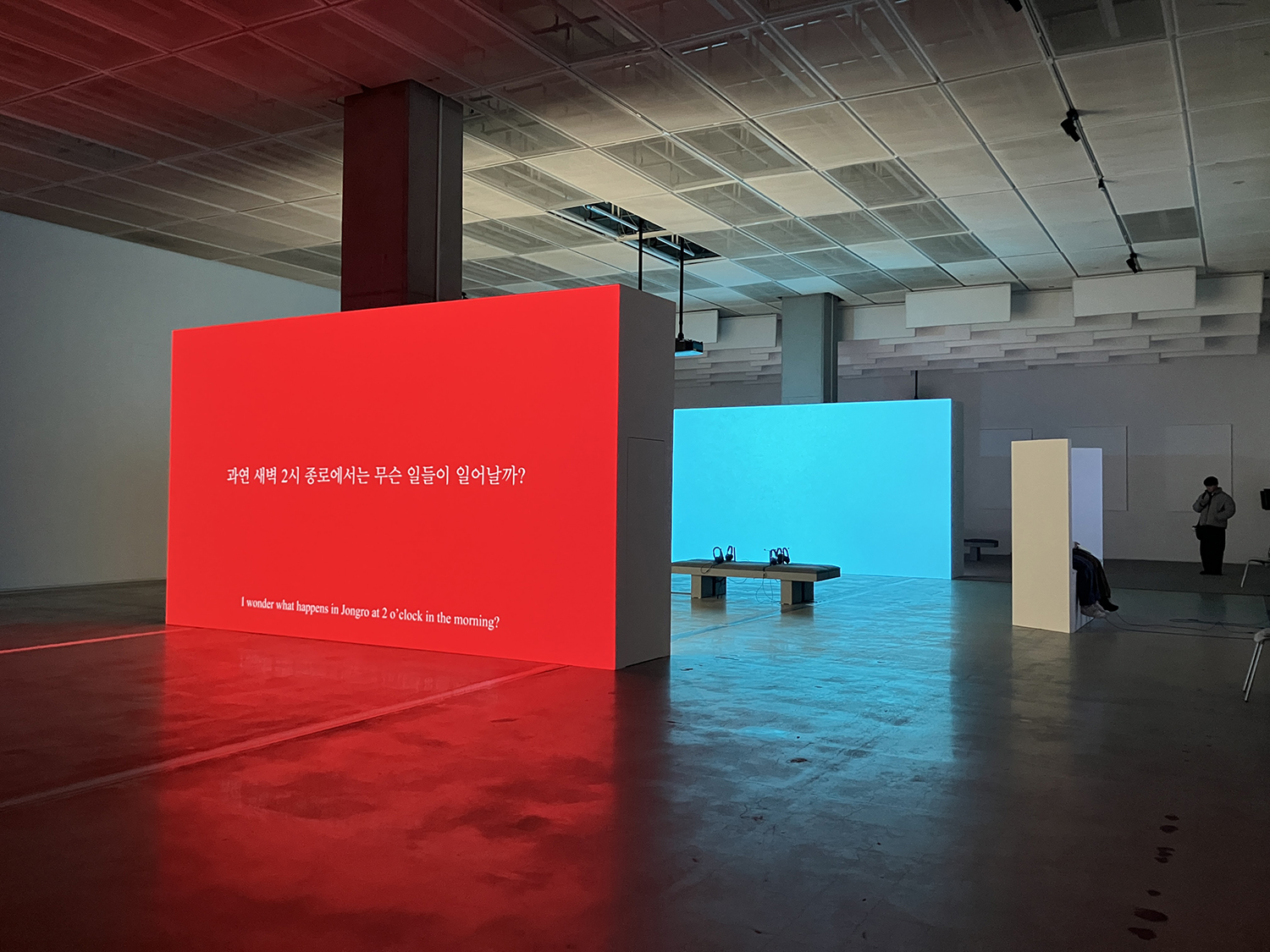
Exhibition view of ‘Korea Artist Prize 2025’; Kim YoungEun ©Lee Sowoon
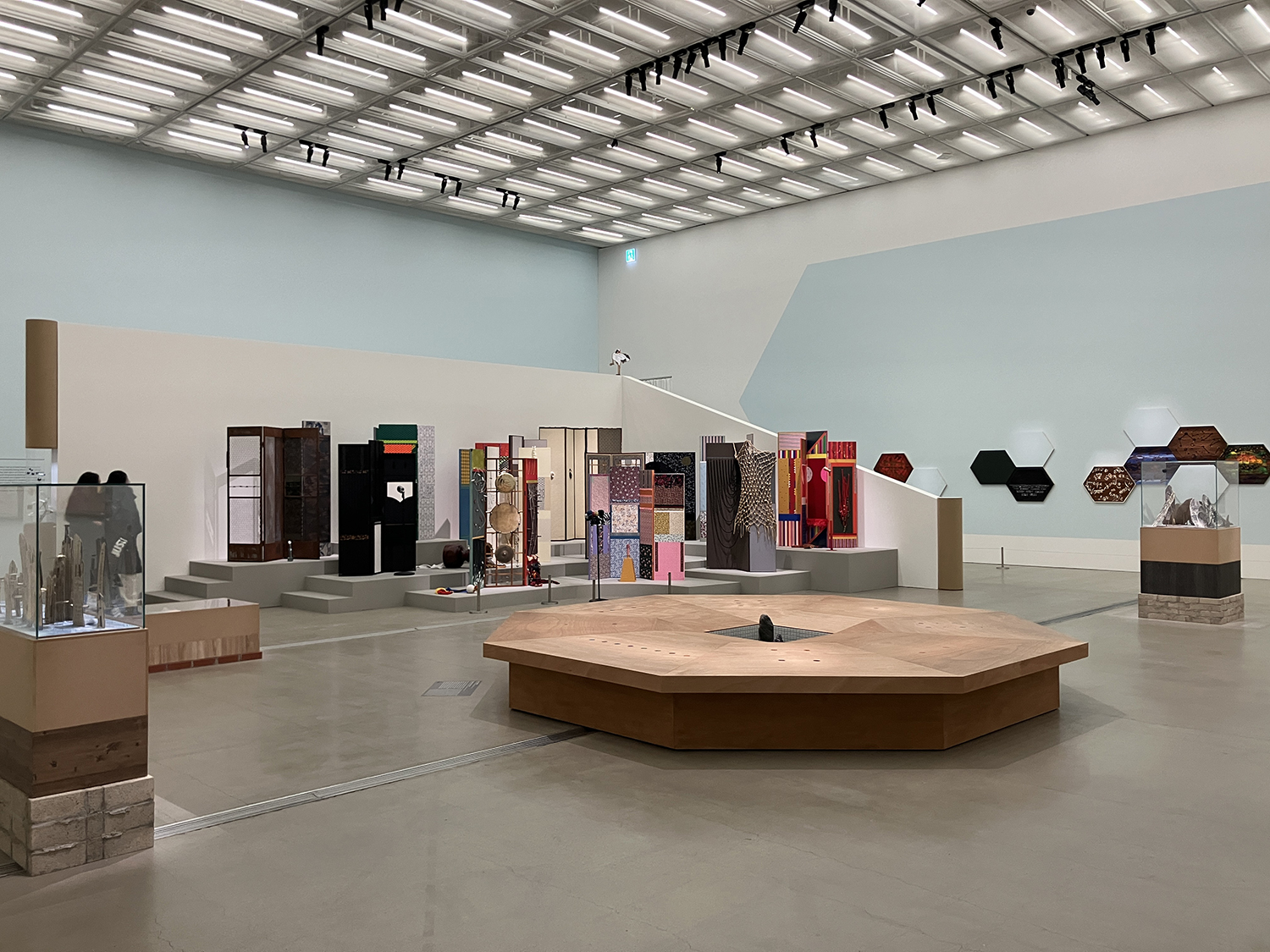
Exhibition view of ‘Korea Artist Prize 2025’; Kim Jipyeong ©Lee Sowoon
‘Korea Artist Prize 2025’, jointly organised by the National Museum of Modern and Contemporary Art, Korea (MMCA) and the SBS Foundation, was held at MMCA Seoul from Aug. 29, 2025 to Feb. 1, 2026. The selected artists (and collectives) were Kim YoungEun, Im Youngzoo, Kim Jipyeong, and Unmake Lab (Choi Binna, Song Sooyon), and the exhibition presented both their new works and key earlier projects.
Kim YoungEun regards the act of listening ‒ audition ‒ as a form of critical practice. She understands listening not as a sense given naturally, but as an outcome socially and culturally trained. Through research into microhistory, she has imaginatively reconstructed the sounds of historical scenes, thereby exposing the structures of power and ideology. Whereas earlier works such as Red Noise Visit (2018) and Ear Training (2022) asked how sound has been recorded and under what conditions it has been heard or erased, based on material and technical traces ‒ or their absence ‒ three new works, including Listening Guests (2025) and Go Back To Your (2025), shift the focus to the artist’s own experience of migration and the languages, music, and everyday auditory worlds of contemporary diasporic communities, examining how these histories give rise to distinct modes of listening.
Im Youngzoo has traced the conditions through which ‘belief’ ‒ invisible yet powerfully life-shaping ‒ has been formed. She focuses on the idea that long-standing superstitions in Korean society, religious faith, and modern science and technology do not belong to mutually exclusive domains, but function as devices invented to manage uncertainty. Her new work They say if you look into a mirror with a knife in your mouth, you will see the future (2025), inspired by the Korean custom of heomyo (empty graves), invites viewers to lie inside a virtual, empty tomb and look up at a ceiling monitor where a face repeatedly ages and then grows young again, confronting another dimension ‒ sky, death, the future ‒ from within the ‘ground’. Here, VR is placed alongside superstitious training methods and is recontextualised as a technology once mobilised to access an invisible world, yet already a failed one.
Kim Jipyeong interprets the concepts and techniques of East Asian art as a flexible structure, viewing that tradition not as something bound to the past but as a generative site for new narratives. Her Polyphonic Chorus (2023 – 2025) series, presented in this exhibition, fills old folding screens with archetypal figures from Korean society ‒ shamans, ajummas, divas, soldiers, office workers, rock stars ‒ thereby transforming the screen into a device for encounter and mediation. The titular work Cosmic Turtle (2025) is a woodblock print composed of eight narratives. It reconstructs an ancient East Asian myth ‒ according to which a turtle bears the entire world on its shell and delivers diagram (do) and writing (seo) to humankind ‒ by linking the myth to a news article that addresses the reality of sea turtles dying after ingesting anti-North Korean propaganda leaflets (ppira). In this process, the diagram of myth is replaced by the language of ideological propaganda; cosmic mythology by modern science; and connection with nature by disconnection.
Unmake Lab has used AI as a medium to critique the anthropocentric cognitive frameworks embedded in the unconscious of a technological society. They employ strategies that inject sensory ruptures into datasets to generate unexpected outputs—for instance, a malfunction in which a stone splashed with ketchup is recognised as a ‘fresh hot dog’ demonstrates how human extractive desire is amplified within technology. Their video work New-Village (2025), shown for the first time in this exhibition, addresses futures imagined through prediction by smart cities. Through an allegorical landscape composed of a simulation village and blue tomatoes, it reveals the limits of a technological imagination that has reduced multiple possibilities to a single forecast. Traversing disparate media and subjects ‒ sound and politics, tradition and art, superstition and science, technology and the human ‒ the works of the four artists (and collectives) are interconnected in that each articulates, through artistic form, an invisible reality that has been concealed, omitted, or marginalised. Following deliberations after the exhibition opened, Kim YoungEun was selected as the final winner on Jan. 14, 2026.
3