
SPACE November 2026 (No. 708)
‘KOO JEONG A: OUSSSMOS’, a solo exhibition bringing together some three decades of Koo Jeong A’s practice, is on view at Leeum Museum of Art from Sep. 5 to Dec. 27. Around 35 works, ranging from early pieces from the 1990s to a new commission for Leeum Museum of Art, extend beyond the M2 galleries into the lobby, the permanent exhibition galleries of M1, and even the gaps in the retaining wall outside the M2 windows. Since the 1990s, Koo has focused on easily overlooked objects: intangible forces that act upon the body and the environment, such as gravity, magnetic fields, light, scent, and sound; and the relationships between them. In the mid-1990s, the artist coined the word ‘OUSSS’, a term that continually enters into new combinations of meaning without ever settling into a fixed definition, and which has appeared in various forms throughout her work over the past three decades. The exhibition title, ‘OUSSSMOS’, combines this word with ‘cosmos’, signifying a world in which disparate objects and forces, memory and time, meet, disperse, and form relationships. Rather than defining familiar reality in terms of a single meaning, it invites us to discover relationships and possibilities within it that ordinarily go unnoticed.
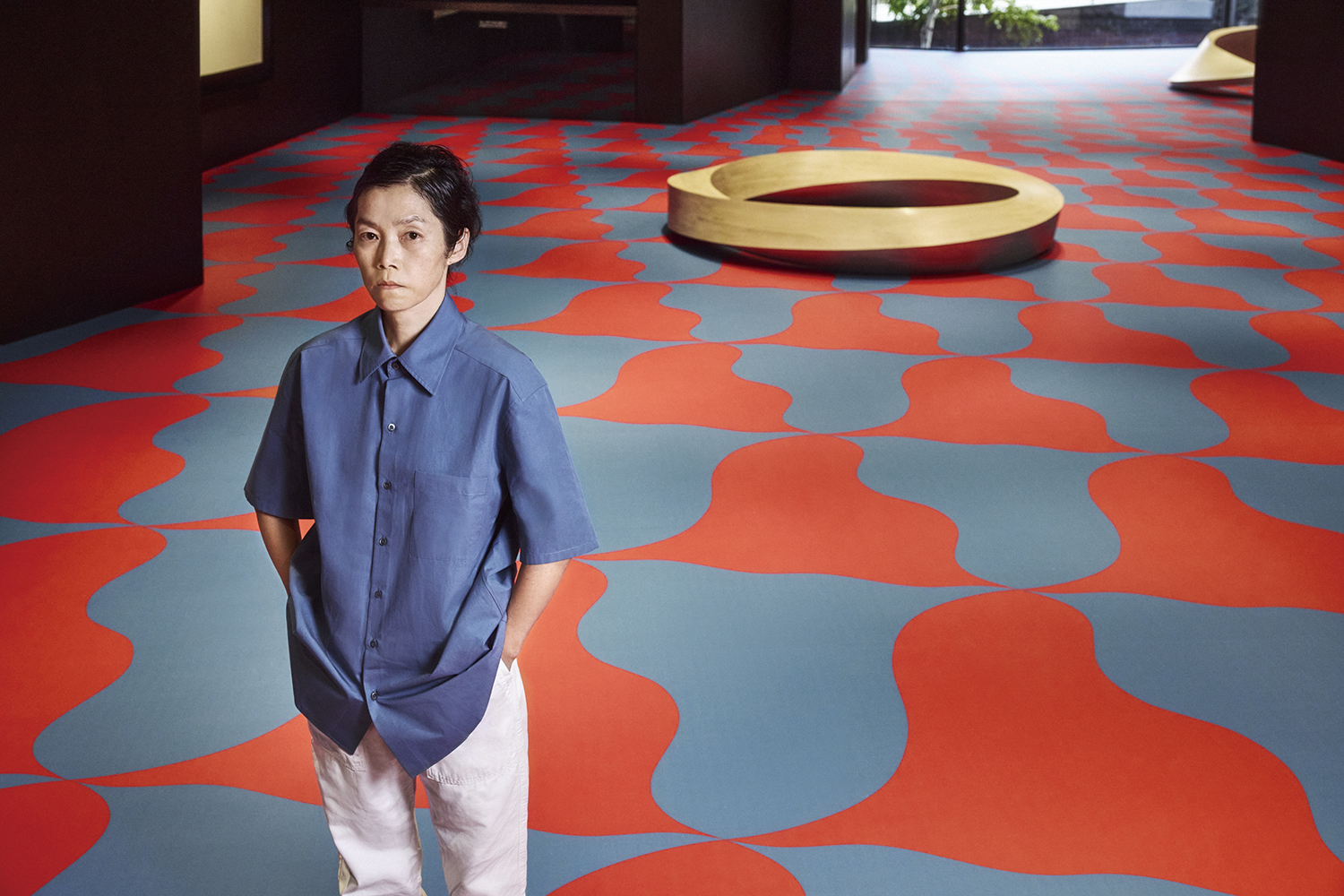
Koo Jeong A with I & THOU (2026) in the background. Image courtesy of Leeum Museum of Art / Photo Mok Jung Wook
Beyond the lobby, the exhibition begins on B1 of M2 with the newly commissioned MOBIOUSSS (2026), which transforms the infinity motif into a large-scale three-dimensional structure, sharing the space with the early work Untitled (1998/2026), in which 57 mechanical-pencil leads are propped against a small recess in the wall. The nearly six-ton stainless-steel structure and the pencil leads, fragile enough to collapse with the slightest vibration, possess radically contrasting material qualities. Yet their juxtaposition reveals the continuity of Koo’s approach, directing attention beyond the objects themselves to the invisible forces and conditions that allow them to be placed and sustained.
From Koo Jeong A’s perspective, M2, designed by Jean Nouvel, is a space in which materials with different qualities, such as glass and steel, encounter one another at varying angles, making it difficult for the gaze to settle in any one place. Across the entire floor, Koo unfolds I & THOU (2026), a pattern of intersecting red and blue. As the pattern increases in scale deeper into the space, the variation in its size exaggerates the sense of perspective. Depending on the direction of view, it appears either elongated or compressed, eventually drawing attention to the floor itself. R (2005), comprising 77 wooden boxes distributed across three gallery spaces, contains 1,001 drawings. Yet only some of the drawings are displayed on the walls, and those on display are periodically rotated throughout the exhibition. Although all 1,001 drawings together constitute a single work, it never reveals itself in its entirety at any one time.
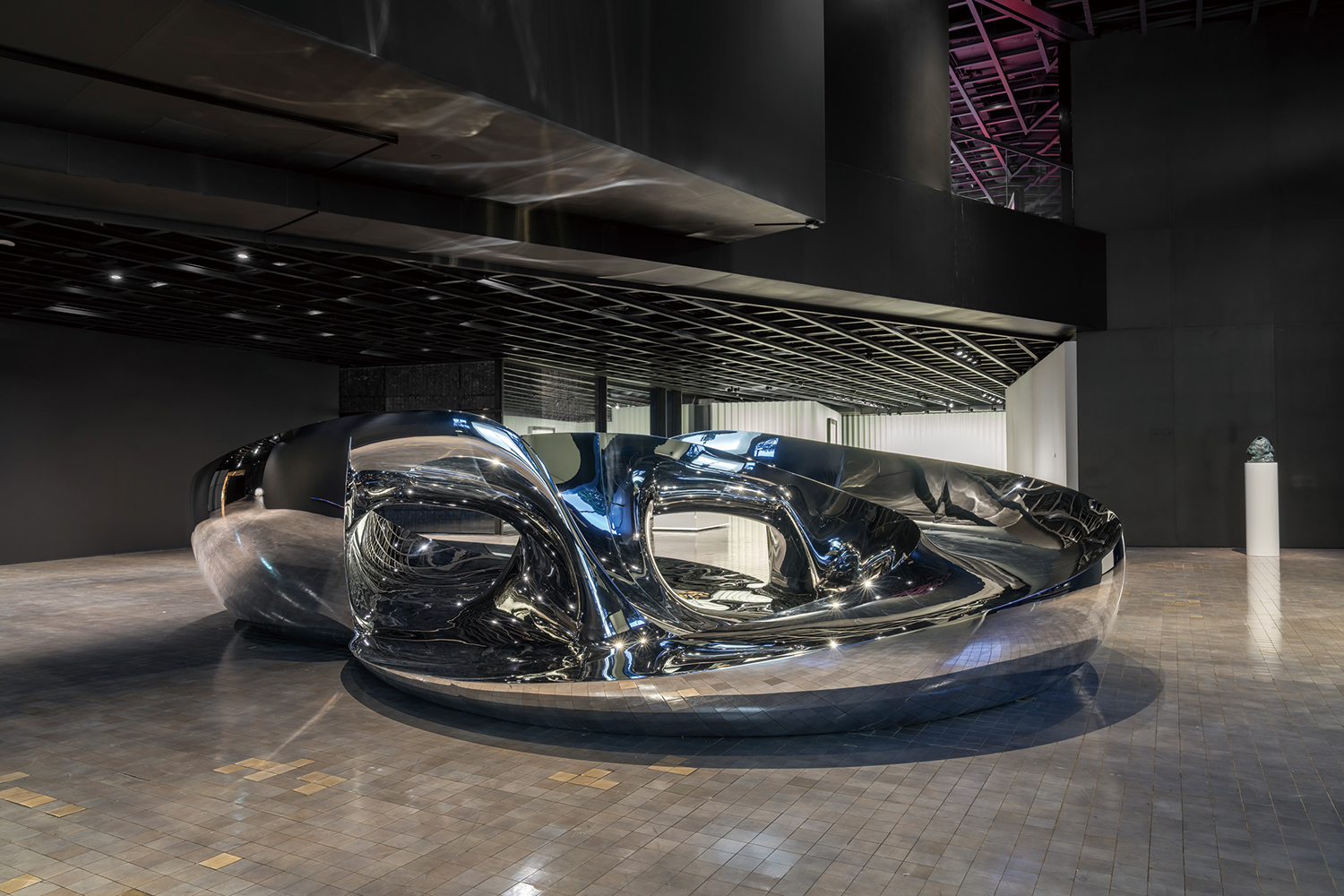 Installation view of MOBIOUSSS (2026) on B1 of M2. Image courtesy of KOO JEONG A and Leeum Museum of Art / Photo Jeon Byung-cheol
Beyond M2, this approach becomes more explicitly about discovery. In the permanent exhibition galleries of M1, DENSITY, GITD (2025), a small stone suspended by a magnetic field, emits a faint glow among centuries-old white porcelain. Hidden within the gabion wall outside the M2 windows is A Reality Upgrade & End Alone (2003/2026), composed of 50 crystals. Only when sunlight strikes the crystal surfaces and the viewer stands where the reflected light meets their line of sight does a momentary glimmer emerge from between the stones. In this way, This exihibition makes what one passes by as much a part of the viewing experience as what one sees, unsettling the sense that the world can be fully grasped through what is immediately visible. In a visual environment where everything is rapidly revealed and consumed, Koo’s work slows the pace of looking and prompts us to examine our familiar reality anew.