




SPACE May 2026 (No. 702)
A New Boundary Blocking the External Gaze
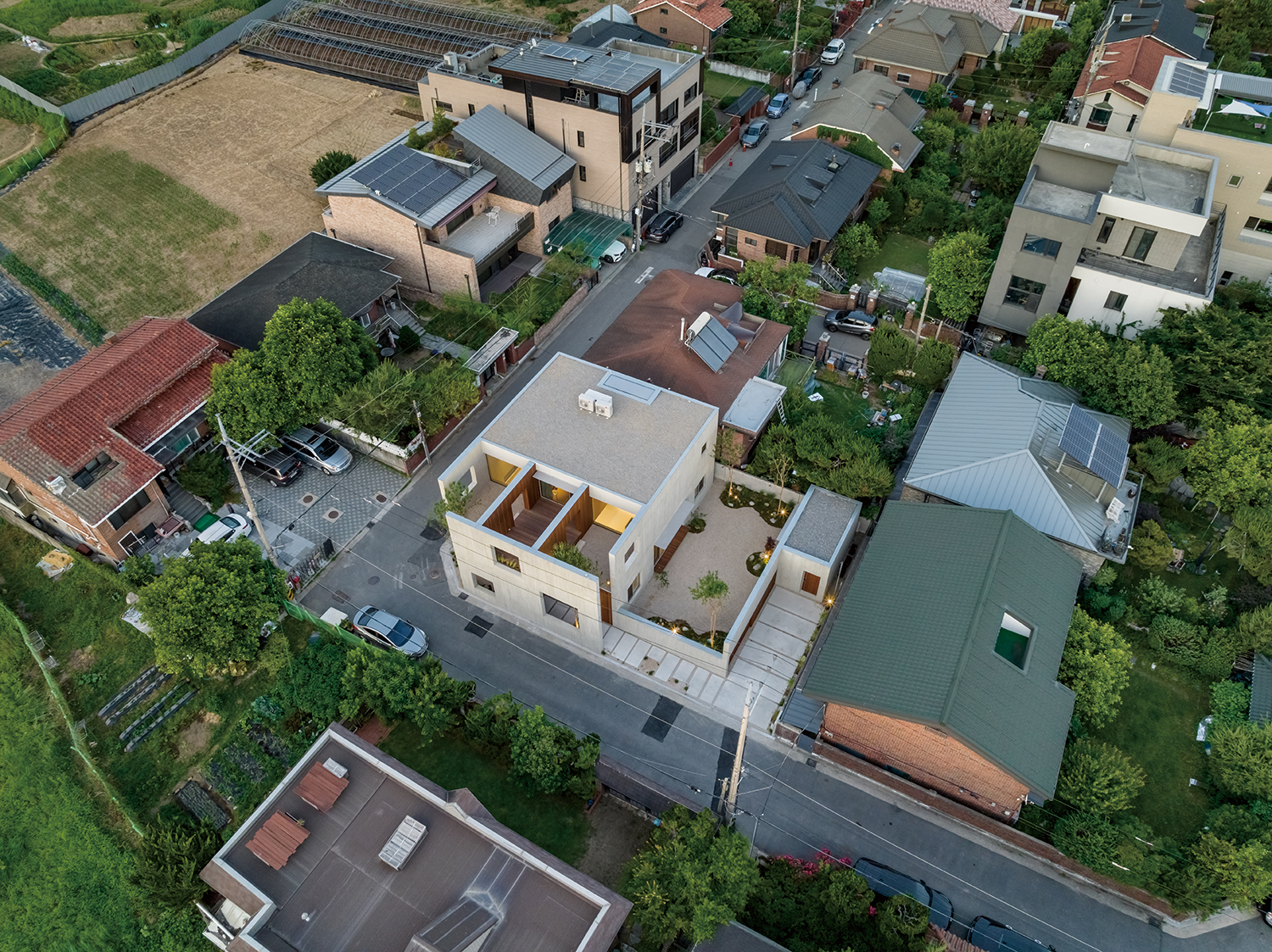
The existing house, located in Seoul, offered almost no protection from its surroundings. With only a 1.5m-high fence and direct sightlines from the neighbouring house’s balcony, the living room and master bedroom facing the yard were always kept behind drawn curtains. In addition, the yard remained largely unused for over 35 years. Perhaps because of this, from our very first meeting the client repeatedly emphasised their desire for a bright and open home, free from the sense of confinement. What seemed necessary was to introduce a new kind of boundary for both the client and the neighbours—one that would no longer be overlooked by neighbours while still allowing extended views outward from within.
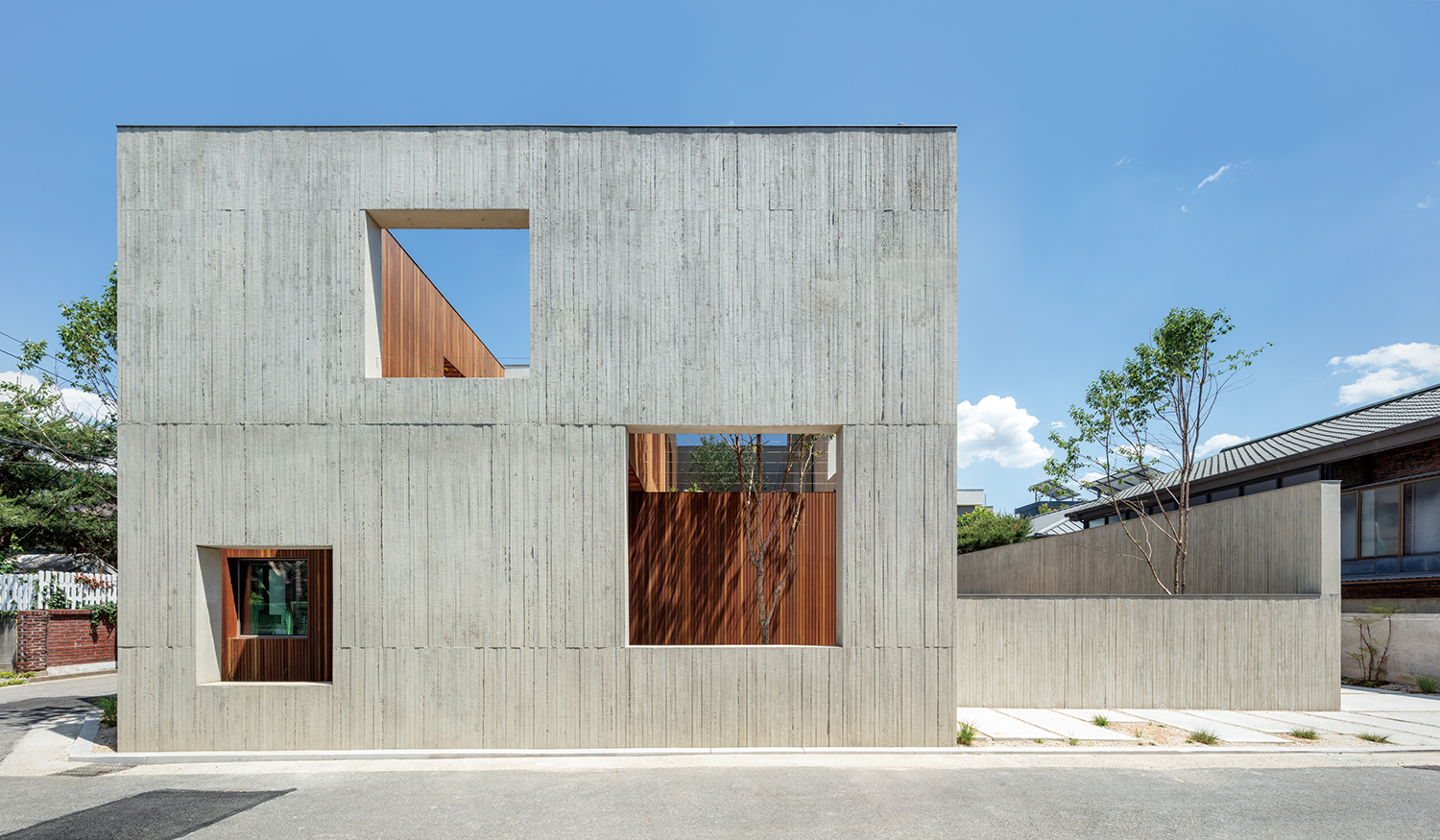
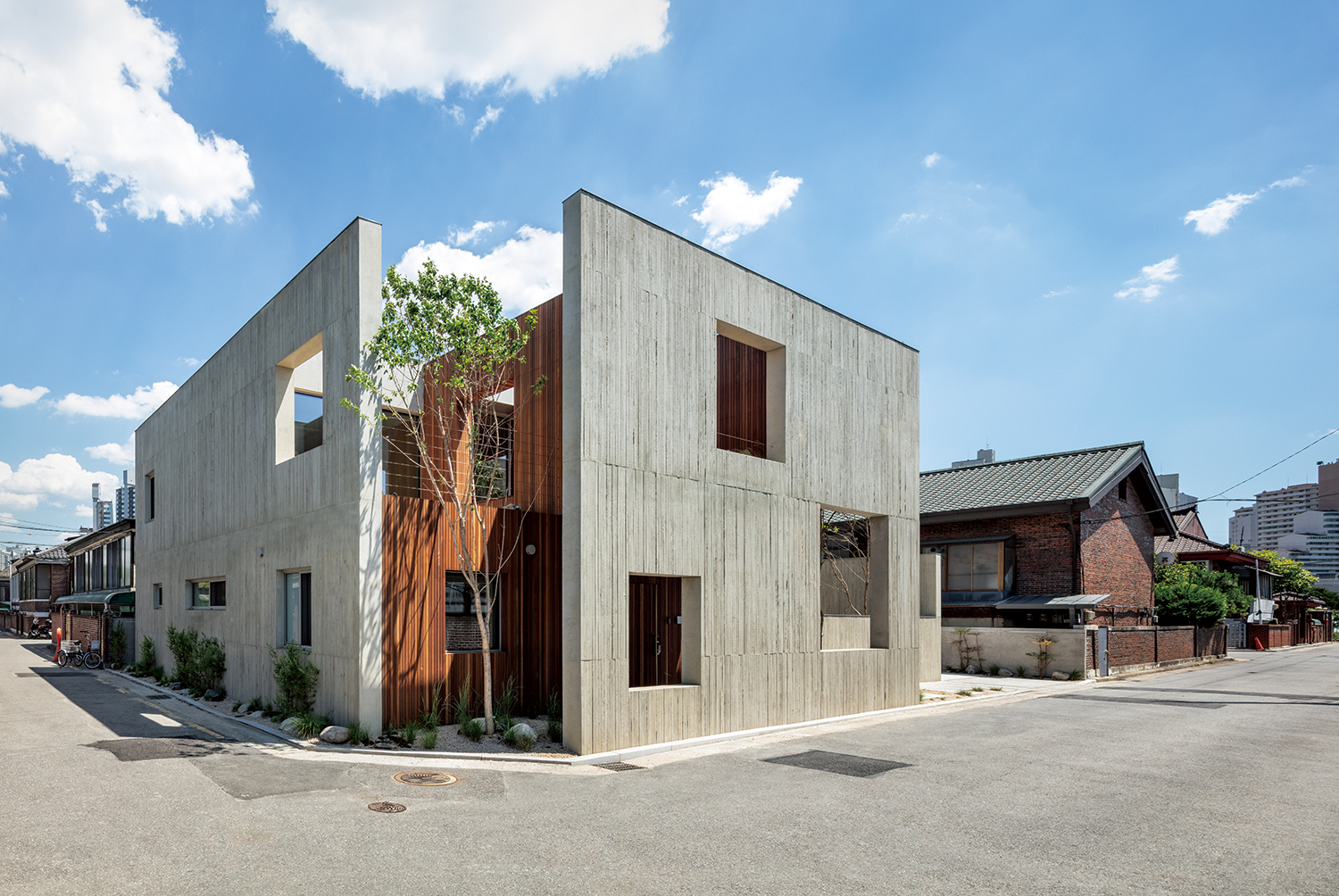
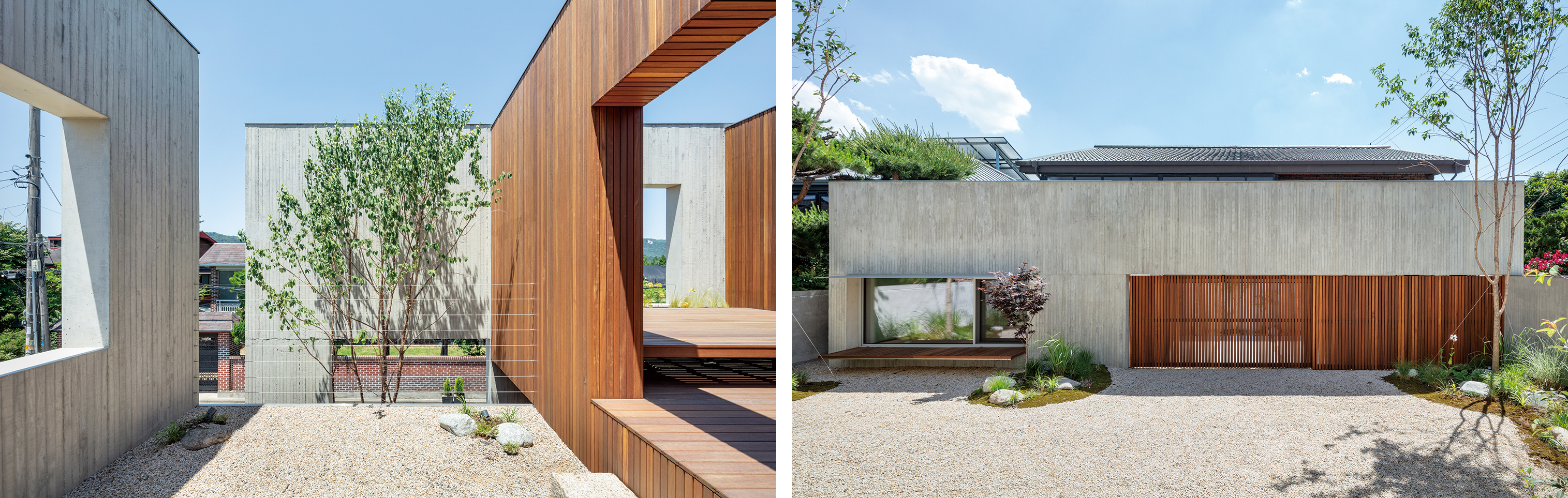
Prior to construction, with the client’s cooperation, we studied the exact positions of windows overlooking the site from the neighbouring homes. The design of any large opening within the shell was based on this survey. For example, a beam extending from the wall of the annex was carefully positioned to block views from the balcony of an adjoining house. Its height was carefully calibrated so that the balcony would not be visible from within the house, while also minimising the shadow cast over the yard. This beam also spans across to the western boundary wall. The height of the western wall itself was determined on site just before formwork installation – by walking along the street from various angles and even standing on tiptoe – at 1.7m, a height that prevents direct views into the yard and interior while still maintaining a sense of openness. The beam and wall together form a new type of boundary, one that frees both the client and neighbouring residents from intrusive lines of sight without creating a sense of enclosure. We later heard that sunlight reflected off the beam now reaches the neighbour’s south-facing balcony, prompting them to open windows that had long remained closed and to begin using the space again. This outcome confirmed that the intervention enabled a more flexible and shared spatial experience for both the client and their neighbours.
Inside and Outside of the Boxes, and a Wall
The client’s son and daughter, who once lived together in the previous house, have since established families of their own. The daughter, now a mother of three, has moved overseas, but during her children’s school holidays she returns to Korea to stay with the client. During these periods, a total of seven people – the daughter’s family of five and the client couple – live together, requiring an environment in which each person’s living domain is secured. In addition, independent spaces were needed to accommodate the differing daily routines and sleep patterns of the client couple.
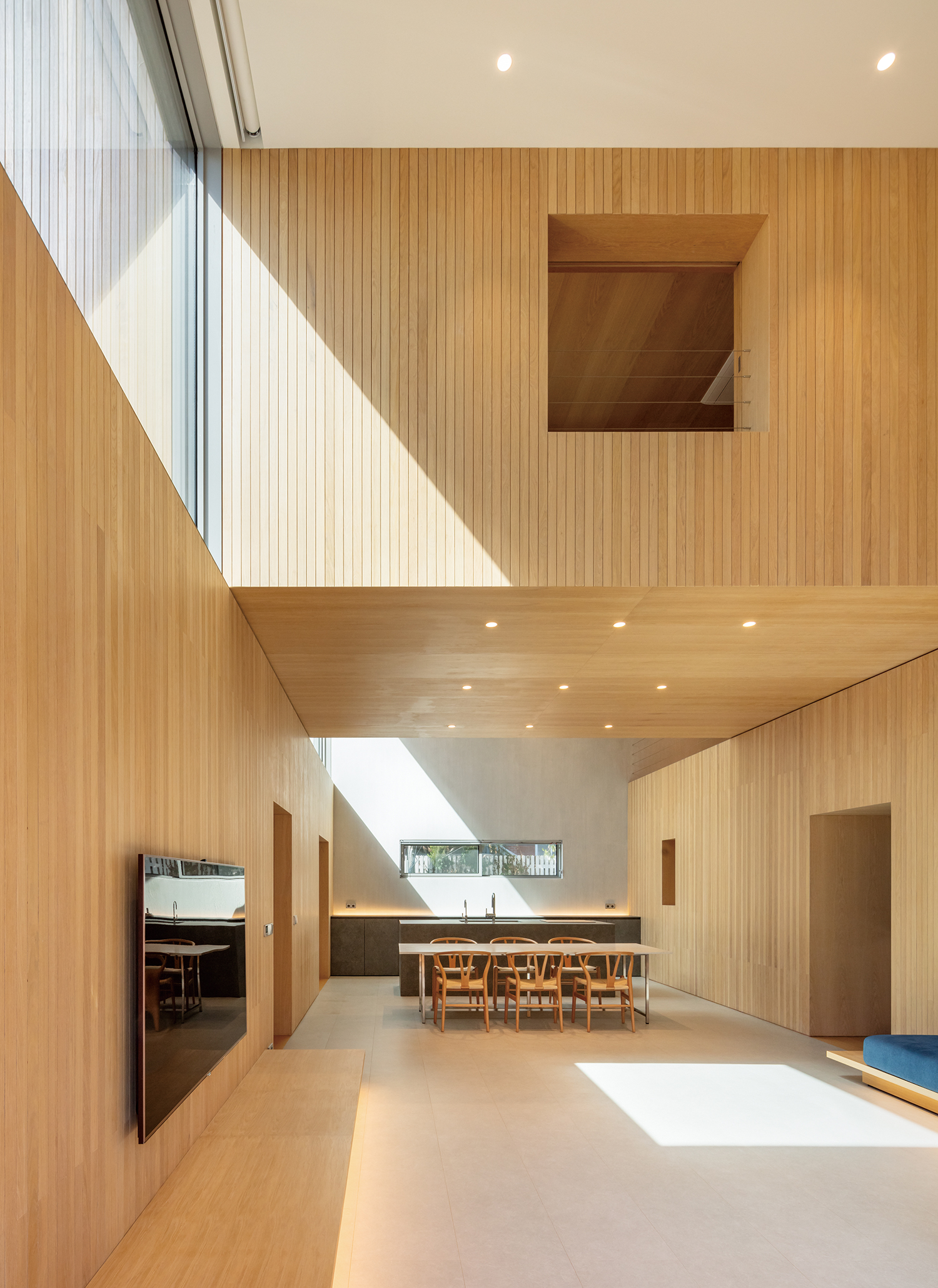
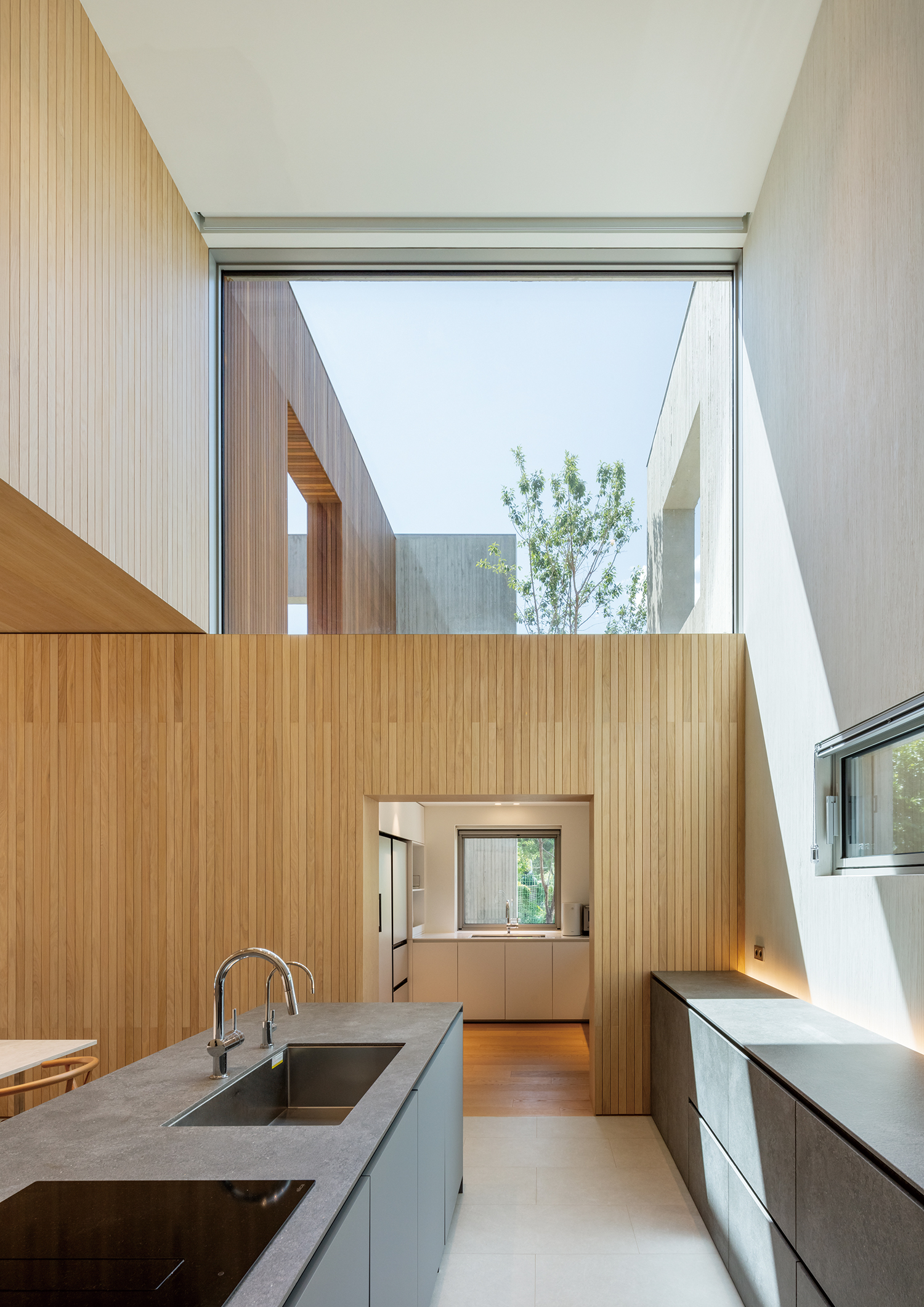
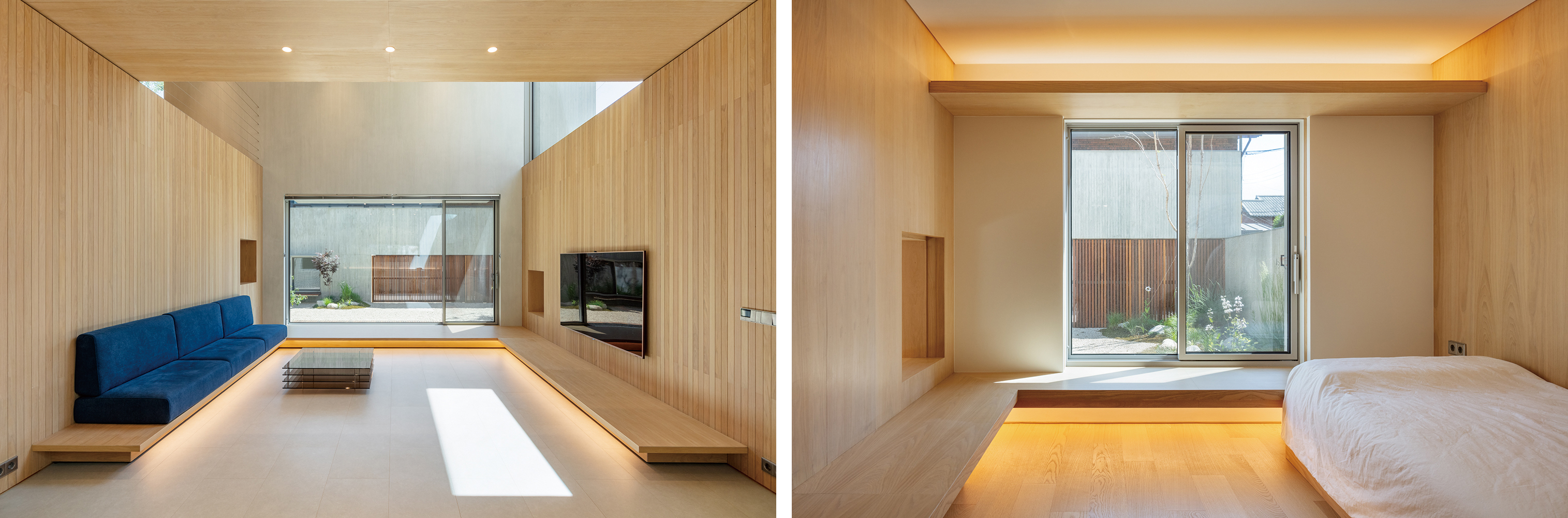
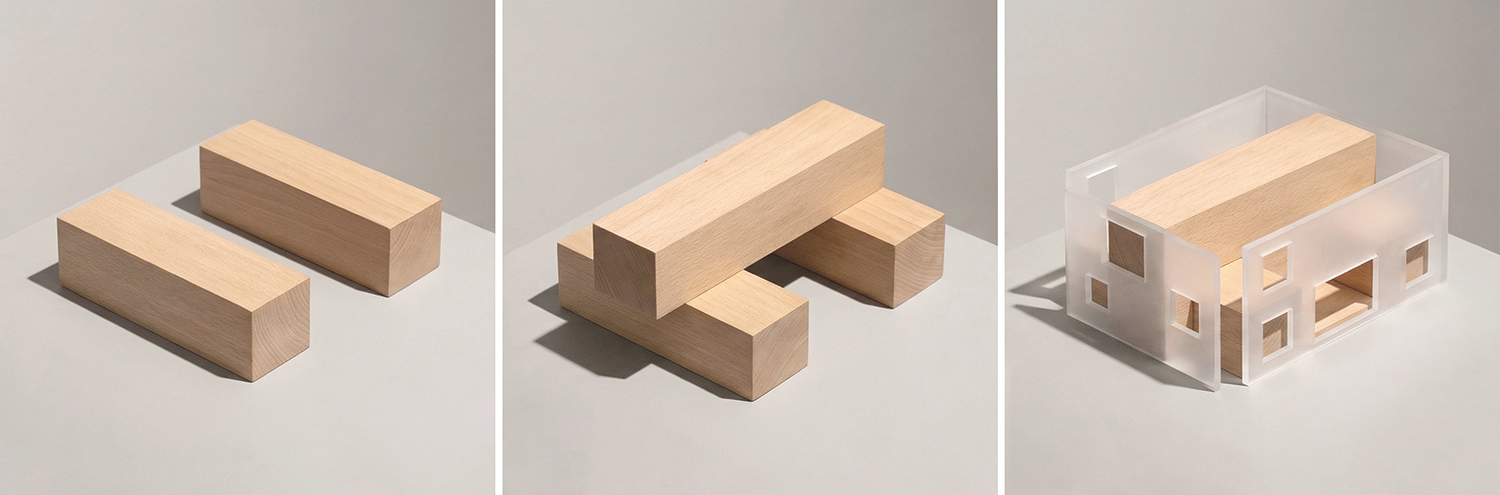
The design first establishes zones that individual family members can occupy, dividing them into areas for the wife, the husband, and the daughter’s family who reside during the holidays. Each wooden box is assigned to a zone. On the first floor, two wooden boxes are allocated to the wife and the husband respectively, while a wooden box on the second floor was allocated to the daughter’s family. These vertically stacked wooden boxes are then enclosed by a concrete outer wall, forming a dual spatial structure of inside and outside the box. The interiors of the boxes are composed of private spaces used by individual family members, such as bedrooms, bathrooms, a secondary kitchen, and dressing rooms. The spaces outside the boxes are arranged as shared areas, including the living room, study, and dining area. Each box is also fitted with inward-facing windows. The husband and wife communicate through interior windows that face each other, while the grandchildren greet their grandparents through the second-floor interior window in the mornings.
Between the two wooden boxes on the first floor there is a bench designed for the extended family, which connects to the interiors of the boxes through internal windows. The low interior windows, aligned with the height of the bench, sometimes become play spaces for the grandchildren. The children move in and out through these interior windows like doors, gathering as they travel between the living room outside the boxes and the bench inside their grandmother’s room.
Aligning Different Materials According to a Common Logic
The exterior timber was used at a width of 45mm, half the width of standard bangkirai decking boards. When arbitrary dimensions are set, additional cutting work is often required to meet those numbers, resulting in significant material loss. While it may seem more economical to use the full 90mm width as is, this is not necessarily the case when considering the installation method. To install 90mm-wide boards, concerns about deformation typically require fastening them to the wall with screws. If the screw heads are to be concealed, additional plug work is needed, which is not aesthetically desirable. Alternatively, deck clips can be used, but these accessories are costly, require grooving along the edges, and complicate installation which therefore increase labour significantly.
By cutting the timber to a width of 45mm, the design achieves a familiar, refined quality associated with standard materials. The boards can be attached directly to the wall using a micro pinner, allowing a single carpenter to install more than twice the area per day compared to conventional methods, greatly improving constructability. The sawn pine boards used for the exposed concrete formwork pattern were also maintained at the same width. Although the materials differ, the consistent proportions and rhythm create a unified impression between the exterior cladding and the concrete surfaces.
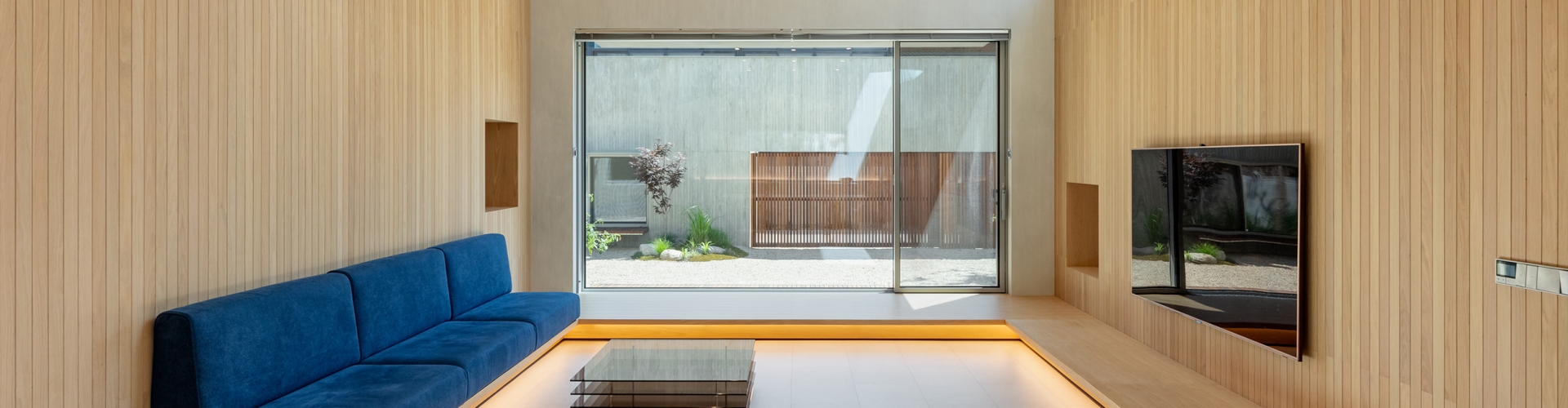
For the living room and study – spaces located outside the boxes – the wall and floor materials were selected to match the colour and texture of the exposed concrete used on the exterior walls. This was intended to evoke a sense of being outdoors, even though one is inside.
Images courtesy of my archive
Applying the Same Material in Different Ways
While white oak was consistently used for both the interior finishes inside and outside the boxes, the method of application varied. Inside the boxes, the timber boards are installed tightly without gaps, creating the appearance of a continuous surface. In contrast, on the exterior of the boxes, the finish followed the same approach as the façade, maintaining a 45mm width with 2mm spacing between boards. This distinction allows the interior and exterior of the boxes to be differentiated despite the use of the same material. From the second floor veranda, which spans both inside and outside, the wooden boxes can be perceived as unified volumes. Through this approach, the boundary between interior and exterior is blurred, reshaping the user’s experience beyond a simple dichotomy of inside versus outside.
my archive (Kim Daehyun, Lee Heimin)
Gangdong-gu, Seoul, Korea
single house
329m²
144.45m²
149.64m²
2F
1
6.7m
43.91%
45.48%
RC
exposed concrete, bangkirai
white oak veneer plywood, rough brushed plaster f
Hangil Structural Engineering
my archive
Oct. 2023 – Apr. 2024
Aug. 2024 – Mar. 2025
Bae Younghee
my archive