
SPACE November 2026 (No. 708)
Monumentality is a key attribute of architecture considered to be a product of society. It publicly expresses what a society chooses to commemorate and the values to which it aspires, thereby allowing individuals to recognise themselves as members of a community. What matters about monumentality, which can often be found not only in memorials to particular individuals or events but also across public architecture, including government buildings and cultural facilities, is that the meaning of commemoration be brought to life in the present. In ‘The Death of the Monument’ (1937), Lewis Mumford argued that the conception of monuments as embodying fixity and permanence could hinder change and renewal in life.▼1 A true monument, rather than fixing memories and values in place, should provide an opportunity for us to interpret and renew their significance collectively in the present, thereby connecting memories of the past with present experience and future aspirations.
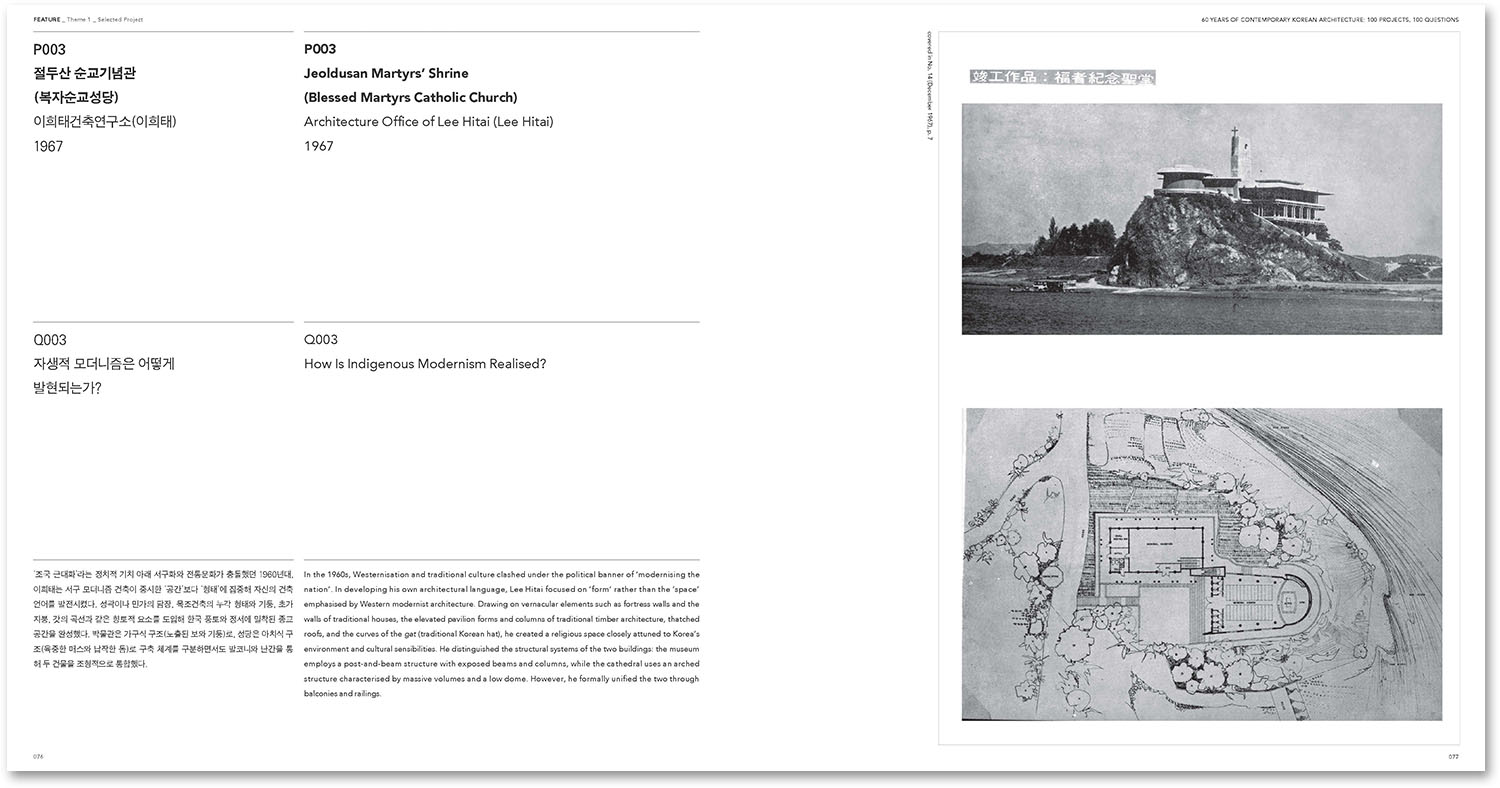
During the period of reconstruction and development following Korea’s liberation from Japanese colonial rule in 1945, a defining characteristic of modern Korean architecture was the close association between monumentality and ‘Koreanness’, particularly its expression in architectural form. A wide range of values, including the distinctiveness of Korean culture, the authority of state institutions, the profound significance of independence, and religious commemoration, were expressed through formal reinterpretations of traditional architecture. Works from the 1960s, including Kang Bong-jin’s National Unified Museum of Korea (now the National Folk Museum of Korea, 1966–1972),▼2 which combined parts from architectural heritages; Kim Chung-up’s French Embassy in Korea (1959–1962), which abstracted the beauty of the hanok roof into the smooth, curved surfaces of reinforced concrete; Kim Swoo Geun’s Korean Pavilion at Expo 67 in Montreal (1965–1967), which reinterpreted the bracket system and rafters of a tiled roof; and Lee Hitai’s Jeoldusan Martyrs’ Shrine (Blessed Martyrs Catholic Church, 1966–1967), which topped a pavilion-like main structure with a roof resembling that of a thatched house, seeking to embody monumental values through their distinct formal interpretations of traditional roof forms and their constituent elements. By contrast, monumental architecture of the 1970s – perhaps partly as a consequence of the 1967 controversy over alleged Japanese influences in the design of the Buyeo Museum, which deeply unsettled the architectural co...